
AFL and NRL Live Betting Deposits via PayID: Quarter-Time Top-Up Timing
 Available in US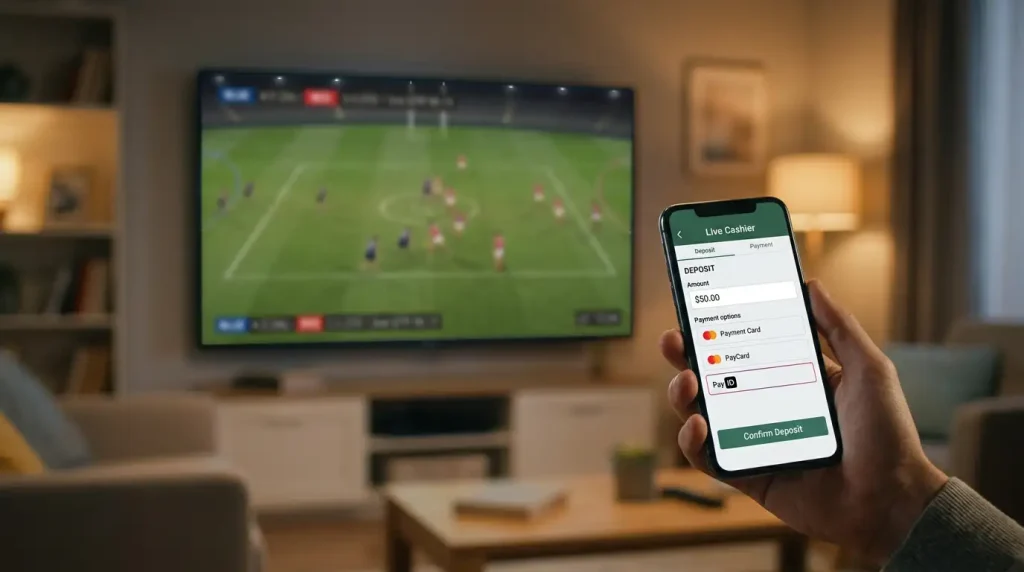
A mate of mine made a classic mistake during an NRL finals match two seasons ago. Down by six with five minutes left in the second half, he decided to back the comeback with a quarter of his weekly staking budget. He tapped Deposit at quarter-to-nine, and by the time the funds reflected in his cashier balance, the market had suspended for the try he was trying to bet against. Nothing was broken. He just ran out of clock.
Live betting is the sharpest timing test any deposit rail faces. Markets open and close in seconds. Odds shift with every play. The window between “I want to bet this” and “the bet is no longer available” can be as short as thirty seconds in the tightest live markets. PayID handles this better than any other rail Australia has, but it does not eliminate the timing problem – it only narrows it. Understanding how narrow is the point of this piece.
How live betting interacts with PayID
The rail underneath PayID is built for speed. More than 155 million real-time transactions cross the NPP every month, with the rail engineered to tolerate downtime of no more than around two minutes per month. For a live betting scenario, that means the rail itself is effectively always on, and a PayID deposit will settle in the target bank inside a few seconds of being sent.
Where live betting stresses the system is at the cashier reconciliation layer. When a punter deposits during a live window, the bookmaker’s cashier backend has to match the incoming payment against the pre-issued reference and update the account balance in real time. For most deposits this happens inside fifteen to thirty seconds end to end. During peak live-betting moments – a close-scoring AFL final, an NRL grand final, a Bledisloe Cup decider – the operator’s queue can briefly lag, stretching the end-to-end timing to a minute or more.
The structural challenge is that live markets move faster than deposit confirmation. An AFL in-play market on a specific scoring shot might be open for thirty seconds. If your deposit takes forty-five seconds to reflect in the cashier, the market you wanted to bet has already closed by the time you could place the bet. No amount of rail engineering fixes this, because the bottleneck is not the rail – it is the gap between your decision to deposit and the funds becoming usable.
The nearly half of registered PayID users who transact via the rail at least weekly develop a feel for how quickly their bank and their bookmaker’s cashier interact. That feel is the practical intuition you build across repeated live deposits. A first-time live depositor who has not used PayID in the specific bank-bookmaker combination before should not make their first attempt in the middle of a close finals match. Test the combination during a low-stakes moment first.
Live betting in Australia has grown substantially as operators have expanded the range of in-play markets offered on AFL, NRL, and other major codes. The sports betting sector generally was worth around AU$6.81 billion in 2024 and is projected to grow at around 22% compound annually through the remainder of the decade. Live-market activity is a major driver of that growth, which is why cashier performance in live windows has become a more visible competitive differentiator among operators.
Quarter-time and half-time top-ups
The natural deposit windows in AFL and NRL live betting are the structured breaks – quarter-time and half-time breaks in AFL, the half-time break in NRL, and any extended pause for video review or injury. These moments give punters a natural pause to assess the state of the match, consider which side of the market looks attractive, and top up their cashier balance for any bets they want to place before play resumes.
The timing characteristics of these breaks are useful for deposit planning. An AFL quarter-time break runs roughly five to six minutes of real time. A half-time break is longer – around twenty minutes including broadcast ads – giving plenty of headroom for deposits. An NRL half-time break is around ten minutes. Any of these windows is comfortably long enough for a PayID deposit to clear and be available for the start of the next play period.
The practical pattern I recommend is this. If you intend to bet during the second quarter of an AFL match, initiate any needed deposit during the quarter-time break rather than during live play of the first quarter. Deposits during active play run the risk of markets moving while funds are settling. Deposits during the break have the full inter-period window to reconcile cleanly.
For half-time betting in either code, the break is usually long enough that deposit timing is not a concern. The cashier has fifteen to twenty minutes to reconcile any incoming PayID payment, which is an order of magnitude more than the rail needs. What matters more during half-time breaks is having a clear view of which markets you want to bet so you can place the bets efficiently once funds are available. The deposit is almost never the friction at this point.
One specific pattern catches some punters off guard. Operators sometimes suspend in-play markets briefly during halftime to update odds based on the match state. If you deposit during halftime planning to bet on a specific in-play market, the market might be temporarily suspended even after your funds have cleared. This is not a deposit problem. It is a market-state problem, and the suspension usually lifts a few minutes into the next period once the operator has re-priced the market.
Saturday racing has its own rush: PayID for horse racing.
When a deposit lands too late
The harder case is when live play is happening, a market is moving, and your deposit does not reach the cashier in time. This happens often enough to be worth planning around.
The first rule is that a deposit sent but not yet reflected does not retroactively activate a market you missed. If the Collingwood over 80.5 points market closed at 2:47pm and your deposit landed at 2:47:30, the funds are sitting in your cashier balance for the next bet but they cannot be used for the bet you were trying to make. The market is closed. Nothing unwinds that.
The second rule is that the funds you deposited are not lost. They sit in your cashier balance and can be used for subsequent markets that do open. If the late deposit cost you one specific bet, move on. Look at the next market. Do not chase the loss by backing a second market you would not otherwise have considered, purely because the deposit is now sitting there.
The third rule is that late-landing deposits are a signal to adjust your habits, not to blame the rail. If a deposit consistently lands too late for the live window you are trying to bet in, the problem is almost always in the pre-deposit phase – you initiated the deposit too close to market close, or you did not factor in your bank’s typical deposit timing. The fix is an earlier deposit next time, not a faster rail.
Operators occasionally refund a late-landing deposit at the punter’s request if the deposit was made with clear intent to place a specific bet that then became impossible. This is not a guaranteed option and not one to rely on, but a polite support ticket explaining the situation sometimes results in a goodwill refund. The ticket should include the deposit timestamp, the market you were trying to bet on, and the time that market closed.
If you find yourself in a pattern of late deposits frustrating your live betting, consider pre-funding your balance before matches start. A punter who deposits AU$200 at 1:30pm before an AFL match starts at 2:20pm has zero deposit-timing risk during the match itself. The balance is there, available, and ready to be deployed in whichever markets the match dynamics point toward. This is the single most effective habit for eliminating the entire category of late-deposit frustration. Think of it the same way you would treat deposit diagnostic checks – the best time to resolve a cashier problem is before the match, not during it.
Safer live deposit habits
Beyond the pre-funding recommendation, a handful of practical habits make live deposits significantly safer and less prone to the timing traps that catch first-time live bettors.
Keep the bookmaker app open on your phone rather than closed between bets. An open app means the cashier is warm, session-authenticated, and ready to process a deposit immediately when you tap Deposit. A closed or backgrounded app sometimes requires re-authentication and a brief reload before the cashier is usable again, which adds seconds you may not have.
Pre-register your bank’s PayID details before the match. Some banks let you save trusted payees so that subsequent payments skip the name-match warning screen. Saving the bookmaker’s PayID as a trusted payee before the match means that live deposits do not require you to scrutinise the name-match screen under time pressure – a step where around one in four PayID users normally aborts their payment mid-flow precisely because the screen is designed to create a moment of caution.
Plan your deposit amounts in advance. A decision to deposit AU$100 made calmly before a match starts is a better decision than a panic AU$250 deposit chased at quarter-time when a team is trailing. Pre-commitment is the easiest responsible-gambling tool you have, and it removes exactly the kind of impulsive decision-making that live betting most exposes punters to.
Set bookmaker-side deposit limits that reflect your pre-match plan. Every licensed operator is required to offer deposit limit tools, and a modest weekly or daily cap enforces your pre-match decisions even if your in-match impulses pull the other way. This is the layer above PayID itself – the cashier layer – and it works regardless of how fast the rail is.
And be honest with yourself about whether live betting is healthy for your pattern of play. The specific dopamine rhythm of in-play wagering is faster than pre-match betting, and the faster rhythm correlates with more impulsive staking decisions for some punters. If you notice that your live-betting weeks are financially messier than your pre-match-only weeks, that is data worth acting on. The rail is fast. The question is whether your decision-making is steady at the rail’s speed.
The wider context sits in our guide to PayID betting in Australia.
