
PayID vs PayTo for Betting: Consent, Mandates and the Next Deposit Rail
 Available in US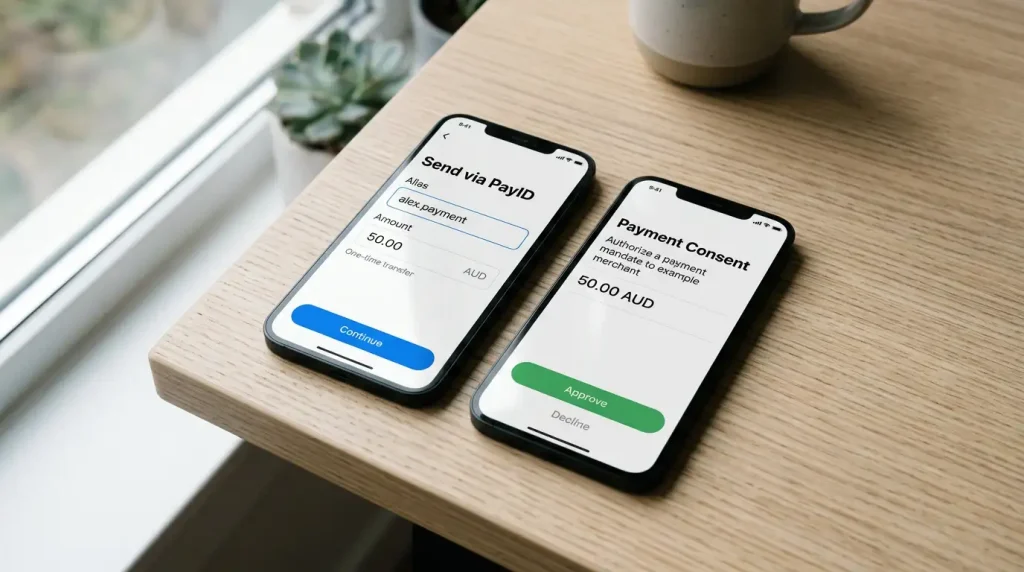
PayTo has been arriving in Australian consumer banking for the better part of two years, but the betting market has barely moved to adopt it. I keep getting asked why – if PayID and PayTo both run on the same NPP rail, why does one dominate bookmaker cashiers while the other is almost absent? The answer is more interesting than “bookmakers are slow to adopt new things,” which is the easy version.
PayID and PayTo solve different problems. One is a way to receive an on-demand payment you initiated yourself. The other is a way to authorise someone else to pull payments from you on an agreed schedule. For betting, that distinction changes everything about how the two rails fit – or do not fit – a punter’s actual relationship with a bookmaker.
Two different rails on the same NPP
Both PayID and PayTo sit on top of the New Payments Platform, which processed around 1.6 billion transactions worth roughly AU$1.99 trillion in 2024 and continues to grow at around 15% year-over-year. The NPP itself is a shared piece of Australian payment infrastructure. Everything that rides on it benefits from the same real-time capability.
What PayID provides is an alias layer over that infrastructure. Instead of quoting your BSB and account number, you can quote a shorter identifier – an email, a phone number, or an ABN – and anyone can initiate a payment to you using it. The initiation happens in the sender’s bank app. You, the receiver, do not do anything at the moment of payment. The alias simply resolves to your underlying bank account and the funds arrive.
PayTo is a different model. With PayTo, you authorise a merchant or service provider to pull payments from your bank account under agreed terms. You set up a mandate – a standing authorisation that specifies the merchant, the amounts allowed, the frequency, and any end date. Once the mandate is active, the merchant can initiate payments against it without requiring you to manually approve each one. Every mandated payment still runs through the NPP, so the settlement is real-time, but the consent is front-loaded into the mandate rather than repeated per payment.
That difference in consent model is the real story. PayID is a pull-from-me decision you make every time you pay. PayTo is a standing-consent decision you make once, with terms that bind future payments. For a simple ad-hoc payment – settling a dinner bill, funding a bookmaker deposit on a Saturday – PayID is the obvious fit. For an ongoing relationship where payments happen regularly – a gym membership, a utility bill, a streaming subscription – PayTo is the better fit.
How PayTo mandates work in practice
Setting up a PayTo mandate follows a specific flow. The merchant sends a mandate request to your bank. The bank notifies you through your banking app, showing you the mandate terms: the merchant, the maximum amount per payment, the frequency, the end date if any. You review the terms, approve them if you agree, and the mandate becomes active.
Once active, the merchant can initiate payments against the mandate at will, within the authorised parameters. Each payment runs through the NPP and settles in near real-time. You can revoke the mandate at any time through your banking app, which ends the merchant’s ability to pull further payments but does not reverse any already-completed transactions.
For a merchant, PayTo offers genuinely new capabilities that PayID does not. Recurring billing without requiring the customer to manually re-authorise each payment. Variable amount collection within mandate caps, so a phone bill that changes month to month can still be collected automatically. Much richer payment metadata than the direct debit system it replaces. And real-time settlement, so the merchant knows immediately whether a payment succeeded rather than waiting for the slow direct debit reconciliation cycle.
For a customer, PayTo offers more visibility and control over authorised payments than the old direct debit framework did. You can see every active mandate in your banking app. You can revoke them in seconds. You can set mandates with cap limits that prevent the merchant from taking more than you agreed to. It is a meaningful improvement over the decades-old direct debit process for anyone who wants tighter control over recurring authorisations.
Why betting use cases do not fit PayTo neatly
Here is where the adoption gap between PayID and PayTo in wagering gets interesting. Most punter-bookmaker relationships are exactly the kind of relationship that does not suit a standing mandate.
Punters deposit irregularly, in varying amounts, based on the specific bets they want to place at specific moments. A rugby league punter might not deposit for two months and then fund AU$200 in one go before a finals match. A racing punter might fund AU$30 on a Saturday morning and nothing for the rest of the week. There is no predictable pattern a standing mandate would capture cleanly.
Worse, from a responsible-gambling perspective, a standing mandate that let a bookmaker pull deposits at will would be exactly the opposite of what the consumer-protection framework is trying to build. The current model requires the punter to actively initiate every deposit, which creates natural pauses where they can reconsider. A mandate that bypasses those pauses would make the deposit process frictionless in a way that would concern regulators.
AUSTRAC’s guidance on the new rails is worth taking seriously here: “AUSTRAC expects institutions to adjust reporting and monitoring for instant transactions under the New Payments Platform (NPP) and PayTo.” The explicit inclusion of PayTo in that statement is not accidental. Regulators see PayTo’s mandate structure as a surface that will attract compliance attention, and any betting-sector adoption of PayTo will sit under that scrutiny from day one.
There are narrow use cases where PayTo could fit betting. A pre-authorised deposit limit that lets a punter set “pull up to AU$100 per week from my bank, no more, no manual approval needed” would actually be consistent with responsible-gambling principles if designed well. A mandate-based loyalty program payment that refunded rake or paid out a subscription-style bonus would fit naturally. Outside those narrow cases, the mismatch between bookmaker deposit patterns and standing mandates is structural.
Consumer control differences between the two
The control story is different in each direction.
With PayID, you control every payment individually. You decide when to send, how much, and to whom. The trade-off is that mistakes are also individual – a wrong alias, a wrong amount, a wrong reference, and that specific payment has issues that you need to chase. There is no standing framework protecting you from a one-off mistake.
With PayTo, your control sits one layer up at the mandate level. You cannot prevent a specific payment from being taken within the mandate’s agreed terms, but you can set mandate terms that cap the damage – maximum amount per payment, maximum frequency, hard end dates. If anything goes wrong, you revoke the mandate and stop future payments. The trade-off is that individual payments within an active mandate are taken without per-payment approval.
For betting specifically, the control model PayID offers is better suited to how punters actually want to interact with bookmakers. You see the deposit screen, you decide, you send. The bookmaker does not have standing authority to take funds. The control is per-transaction and it sits entirely with you.
The few AU bookmakers that have signalled interest in PayTo tend to position it as a complementary option for specific use cases – refunding rake, paying loyalty benefits, or possibly supporting a specific type of subscription-style product – rather than as a replacement for PayID as the primary deposit rail. That positioning is probably the right one. PayTo is not a better PayID. It is a different rail that solves different problems, and wagering happens to be a category where PayID’s problem is the dominant one.
As more bookmakers begin to experiment with PayTo mandates, the broader question of rail choice will matter more to bettors. For now, the practical reality is simple: PayID is the deposit rail for licensed Australian wagering in 2026, PayTo is a possible future option for specific narrow cases, and the NPP underneath both continues to carry the bulk of real-time payment traffic in Australia. I have covered the broader distinction between Osko and PayID separately for punters who want to understand the full shape of the rail stack.
The alias layer is explained in Osko vs PayID.
The wider context sits in our guide to PayID betting in Australia.
