
Osko vs PayID for Betting: The Rail Below the Alias, Clarified
 Available in US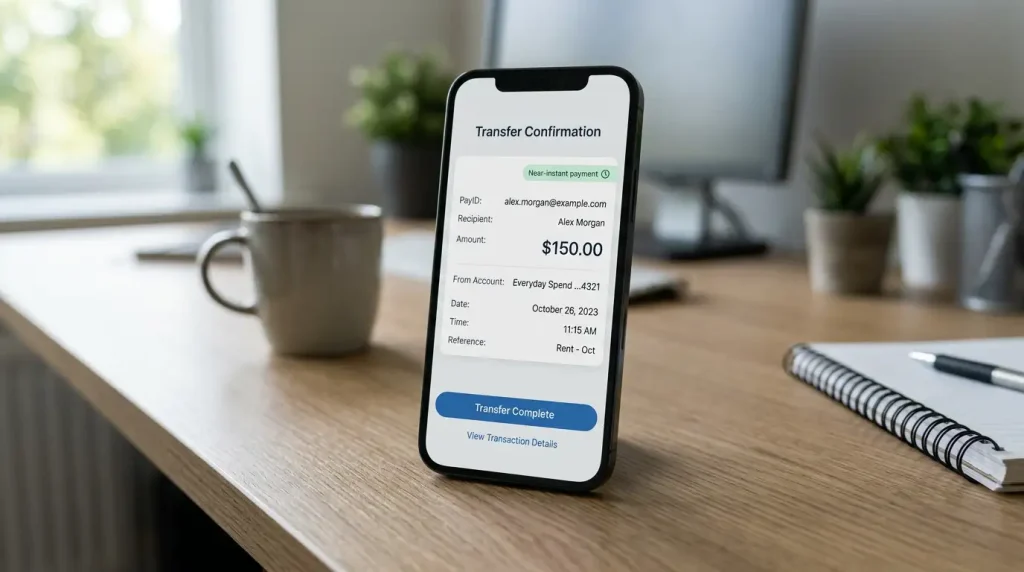
I spent a confusing ten minutes on the phone with a reader last month who insisted her bank had “downgraded” her PayID to Osko after a recent app update. She pointed to the bank’s own description of an outgoing payment as “Osko” rather than “PayID” and assumed something had broken. Nothing had broken. Her bank had just labelled the payment by the layer underneath it.
This is one of those confusions that is almost entirely a naming problem, not a technical one. Osko and PayID are not competitors. They are adjacent layers on the same infrastructure, and understanding which is which clears up a surprising amount of everyday banking-app confusion for any punter who moves money to bookmakers regularly.
What Osko is, and what PayID is
The New Payments Platform launched in 2018 as shared Australian real-time payment infrastructure. Osko was the first consumer-facing overlay service to run on top of it, originally developed by BPAY, and for the first phase of the NPP’s life Osko was effectively synonymous with real-time payments in Australian banking apps.
PayID arrived alongside Osko as a separate capability – an alias layer that let customers receive payments using an identifier like an email or a phone number instead of a BSB and account number. PayID can be used to initiate a payment over the NPP. So can Osko. They are different features of the same underlying rail.
The distinction is easiest to see at the transaction layer. The NPP is the rail. Osko is a branded overlay service that uses the rail. PayID is an addressing system that also uses the rail. You can send a payment using PayID as the address and Osko as the overlay service in a single transaction. The bank app might label that transaction as “Osko,” “PayID,” or both, depending on the bank’s UI conventions.
Over time, the distinction between Osko and direct NPP payments has become less meaningful for consumers. Most NPP payments today run without the Osko branding on the sender or receiver side, and the payee-name verification features that Osko originally highlighted are now part of the broader NPP capability rather than Osko-specific. Newer consumers rarely encounter the Osko name at all unless their bank specifically surfaces it in their app.
The scale of the underlying NPP has grown enormously since those early days. More than 155 million real-time transactions cross the rail every month, with more than 110 Australian banks and credit unions participating. The alias layer – PayID – has scaled alongside, with more than 25 million aliases registered by early 2025. Osko as a branded overlay has not scaled in the same way because consumers increasingly see NPP payments as a generic capability rather than a specific product.
How each shows up in bank apps
The way a bank labels an outgoing payment depends on the bank’s UI conventions, not on any hard rule about which brand applies.
At one major Australian bank, outgoing PayID-addressed payments are labelled as “PayID” in the transaction history. At another, the same payment shows as “Osko Payment to [alias].” At a third, the label is simply “NPP Transfer” with no overlay-service reference at all. None of these labels mean different things in terms of where the money went or how fast it settled. They are different ways of describing the same transaction.
For punters funding bookmaker accounts, this label variability can be confusing when you compare transaction histories across multiple banks. A PayID deposit to bet365 from a Commonwealth Bank account might show one label. The same payment from an ANZ account might show another. The funds moved identically. The labels differ.
The practical advice is to focus on the substance of the transaction rather than the label. What matters is the payee name that resolved when you entered the alias, the amount, the timestamp, and the reference. The overlay-service label – Osko, PayID, or neither – is essentially cosmetic from a recovery or support perspective. If you need to prove a payment to a bookmaker’s support team, the alias, the amount, and the reference are what they will ask for. Whether your bank labelled it Osko or PayID is irrelevant.
One nuance worth flagging. Some older bank UIs still use the Osko label for payments that are pull-triggered by phone number or email, and the PayID label for payments specifically addressed to a registered PayID alias. In practice both are real-time NPP payments and both are handled the same way by the receiving bank, but the distinction in the sending bank’s UI can create the impression that two different things are happening. They are not.
Which shows up in the bookmaker cashier
The answer is simple and consistent across the licensed Australian market: the cashier surfaces PayID, not Osko.
The reason is straightforward. The cashier needs to give you an address you can enter into your banking app. PayID aliases – emails, phone numbers, ABNs – are the only addressing scheme over the NPP that is suitable for that purpose. Osko as an overlay service does not provide its own addressing scheme. It sits on top of either direct bank-account addressing, PayID addressing, or both.
When you tap Deposit on a licensed bookmaker and select the real-time rail option, the option will be labelled PayID. The alias you are given will be a PayID alias. The payment you initiate in your bank app will be a PayID-addressed NPP transaction, with or without Osko branding depending on your bank’s UI.
No licensed Australian bookmaker I am aware of offers a cashier option labelled Osko. The underlying rail is shared but the consumer-facing product that bookmakers integrate is PayID. That is where the naming convention settled in the wagering market, and it is unlikely to shift unless Osko as a brand makes a comeback in consumer banking more broadly – which currently does not look likely.
The only place the Osko label might still appear in a betting context is in the bank-app description of an outgoing payment to a bookmaker. If you send a PayID payment to Sportsbet and your bank labels it “Osko Payment to [alias],” that is still a PayID deposit from Sportsbet’s perspective. The labelling is a bank-side detail, not a bookmaker-side one.
The receiving side tells the same story. When Sportsbet’s back office receives a PayID-addressed NPP payment, it reconciles it against the alias and reference it issued. The reconciliation does not care whether the sender’s bank happened to brand the payment as Osko. The settlement is settlement. The rail is the rail.
Does it matter for confirmation speed
Not meaningfully, and this is where a lot of the confusion gets resolved. Whether a payment is labelled Osko or PayID in your bank app, the confirmation timing is governed by the underlying NPP rail, which is engineered for near-instant settlement with availability tolerances measured in minutes per month of downtime rather than hours.
What actually varies in confirmation speed is the operator’s cashier reconciliation layer, your bank’s inbound or outbound processing, and the per-transaction risk scoring that runs in real time. None of those variables track with Osko versus PayID labelling. An Osko-labelled PayID deposit from Commonwealth Bank to a bookmaker cashier will typically land in the same timeframe as a PayID-only-labelled payment from a bank that does not surface the Osko brand.
The exception that sometimes fools people is the first-payment hold. First PayID payments to new payees at some banks sit for up to 24 hours on a precautionary review, which is the subject of its own discussion in a piece I wrote on the 24-hour first-payment hold. That hold applies regardless of whether the outgoing payment is labelled Osko or PayID in the bank app – the hold is a bank-side risk measure, not an overlay-service feature.
There is one small wrinkle worth noting. Some bank UIs, particularly older ones, still distinguish between Osko Pay Anyone and PayID as separate options at the outgoing-payment-selection step. If you select the Pay Anyone option and type in the bookmaker’s alias manually rather than choosing the PayID option directly, the payment is still routed correctly because the alias resolution happens at the rail level. The bank’s UI may label the transaction differently in your history. The substantive outcome is the same.
The broader cost structure of the rail is worth knowing. The NPP’s wholesale transaction cost has dropped from around AU$0.39 in 2019 to roughly AU$0.04 in FY25, which is why bookmakers lean so heavily on the rail for deposits – it is dramatically cheaper than any card-acquiring alternative. I have written separately about where the rare PayID betting fees actually come from, because the overall free-to-punter cost structure is not an accident of market convention but a direct consequence of the rail’s economics.
The next rail question is PayID vs PayTo.
The wider context sits in our guide to PayID betting in Australia.
