
PayID Minimum Deposits: Where $5 and $10 Entry Points Actually Exist
 Available in US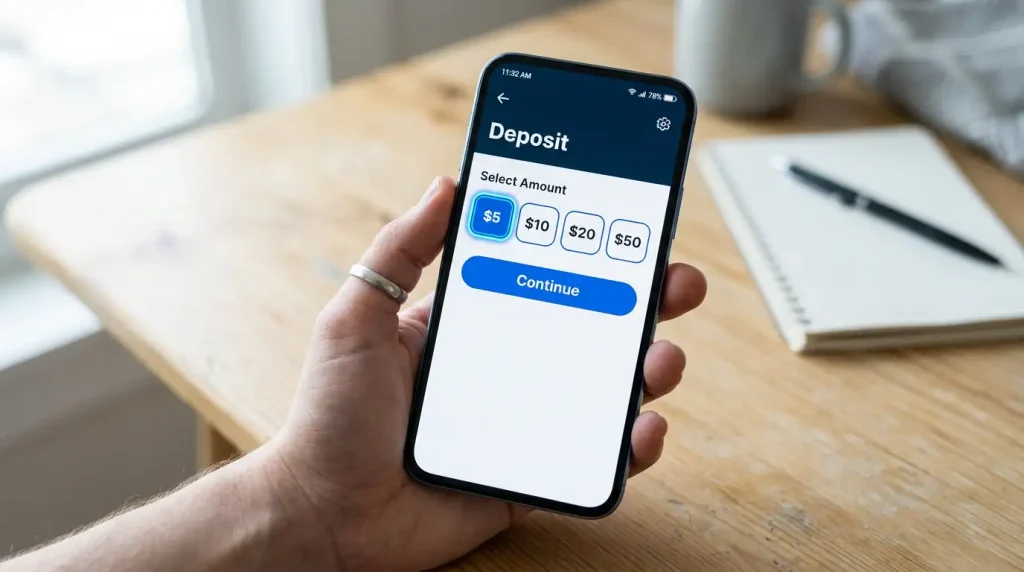
The low-minimum deposit question comes up more often than you might expect. A reader asked me last autumn whether there was any licensed AU bookmaker that would take a genuine AU$5 PayID deposit for a one-off Melbourne Cup flutter. She did not want to open an account with a large balance. She wanted the absolute minimum viable deposit to place one bet and be done.
The answer turned out to be more nuanced than I expected. Some operators do accept AU$5. Others float the floor at AU$10. A handful set it higher, usually for specific account types or promotional pathways. The floor you actually encounter is a product of operator choice rather than rail mechanics, and understanding why the floors sit where they do is useful for any punter managing a small bankroll.
Why minimums vary across the licensed market
The NPP rail itself does not impose a minimum on PayID transfers. You can send AU$0.01 between personal accounts through PayID if you really want to. The minimums you encounter at bookmakers are set by the operator, not the rail, and they reflect the operator’s view of where the cashier economics make sense.
Every PayID deposit the operator receives incurs the underlying NPP transaction cost of around AU$0.04. A AU$5 deposit consumes that cost as a meaningful percentage of the transaction value. A AU$100 deposit consumes the same cost as an almost negligible fraction. From the operator’s perspective, very small deposits are structurally less profitable per transaction than larger ones, and the minimum deposit floor is one way operators manage the economics of low-value cashier traffic.
There is a second consideration too. Account setup, KYC verification, BetStop checks, and ongoing compliance apply identically regardless of how much the punter deposits. The operator incurs roughly the same fixed cost onboarding an AU$10 depositor as an AU$1,000 depositor. Setting a reasonable minimum prevents the operator from being swamped with accounts that will never produce enough revenue to cover their own onboarding overhead.
The balance the operator is trying to strike is between accessibility – low minimums reduce friction and bring in new customers – and unit economics. The market has broadly settled on AU$10 as the standard minimum, which is low enough to feel accessible to first-time punters and high enough to keep the cashier economics workable. Some operators deliberately undershoot this to stand out in acquisition marketing. Some push above it to filter for more serious depositors from the start.
The broader impact of even small frictions on betting behaviour has been studied recently. Economists at the e61 Institute noted that “the credit-card ban demonstrated that gambling behavior is responsive to policy, especially when frictions disrupt impulsive betting.” The same principle applies in reverse to deposit minimums. Low minimums reduce friction and make deposits more impulsive. Higher minimums add friction and encourage more deliberate staking. Both effects are real and both matter for how punters interact with the licensed market.
Bookmakers with AU$5 and AU$10 PayID entry points
The AU$5 floor exists at a small number of licensed operators, usually as a deliberate marketing differentiator rather than an accident of cashier design. Among the handful of operators I have verified offering PayID deposits down to AU$5, the pattern is consistent: the operator positions the low floor as part of a broader low-friction proposition, often paired with equally low bet-side minimums and a cashier UX that emphasises quick in-and-out play.
The more common entry point is AU$10, which sits across essentially the entire mainstream market. Sportsbet, Ladbrokes, Neds, bet365, betr, Palmerbet, Unibet, Dabble, Picklebet, and the vast majority of mid-tier licensees all set their PayID minimum at AU$10. This is the default expectation you should have when depositing at any operator in Australia unless you know otherwise.
What AU$10 buys you in practice depends on the operator. At some bookmakers, a AU$10 deposit is enough to place a single standard bet at typical minimum stakes. At others, particularly those oriented around multi-leg racing markets, AU$10 funds several small bets or a single slightly larger one. The deposit minimum and the bet minimum are separate decisions, and the combination determines how usable a small starter balance actually is.
Deposits below AU$10 are uncommon enough that I would be cautious about any operator claiming to accept, for example, AU$1 PayID deposits. Either the operator is a genuine accessibility-focused licensed brand that is taking a loss on small deposits as a deliberate strategy, or the cashier is not behaving as advertised. The quickest check is the same one that applies to every PayID deposit: verify the registered payee name your bank app pulls, cross-check against the operator’s documented entity, and only proceed if everything lines up.
Bookmakers with higher PayID floors
At the other end, some operators set PayID minimums above AU$10 – usually at AU$20 or AU$25. The reasons vary but the pattern tells you something about how the operator thinks about its customer base.
Operators aimed at higher-stakes punters sometimes set higher minimums to filter for the kind of customer they want to acquire. A AU$25 minimum signals that the operator is not trying to capture the casual-flutter market and is willing to trade volume for quality. This is a conscious positioning choice and not an error.
Some operators apply higher minimums specifically to PayID while keeping lower minimums on card or bank-transfer methods. This is rarer and economically questionable – PayID is cheaper to process than cards on average – but it occasionally reflects a specific cashier configuration that has not been updated as the rail’s economics have improved.
UltraBet’s AU$0.50 surcharge on PayID deposits under AU$20 effectively functions as a higher practical minimum for small deposits, even though the nominal floor is AU$10. A punter depositing AU$10 at UltraBet pays AU$0.50 in surcharge, which means the effective cost on a small deposit is 5% of the deposit value. For a AU$5 deposit if the cashier accepted it, the surcharge would be 10%. This design pushes depositors toward AU$20+ amounts, which is where the surcharge disappears.
If you are strictly minimising your deposit amounts, the AU$10 standard floor is where the overwhelming majority of the market sits, and venturing either above or below that level is worth checking against the specific operator’s published cashier terms before assuming.
The ceilings are covered in maximum PayID deposit limits.
What changes with promotional rules
The minimum deposit you can technically send and the minimum deposit you need to send to unlock a specific promotion are often different numbers. This is the source of a surprising amount of confusion.
A typical pattern: an operator runs a signup bonus that requires a first deposit of AU$50 or more to unlock a matched-bet credit. The cashier still technically accepts AU$10 PayID deposits – nothing prevents you from depositing below the promotional threshold. But the bonus does not activate unless the deposit crosses the advertised minimum. If you deposit AU$10 thinking you will qualify for the bonus, you will not, and the signup bonus opportunity on that account may be gone permanently because most operators only honour signup bonuses on the first qualifying deposit.
The practical advice is obvious: always read the promotional terms before depositing during a signup flow. If you intend to use a specific bonus, deposit exactly the amount the bonus requires or slightly above. If you are not chasing a specific bonus, the standard AU$10 floor applies.
Ongoing promotional deposits sometimes work differently. A cashback promotion might activate on any deposit of AU$20 or more for a specific weekend. A deposit-match promotion might require AU$100 to unlock the match portion. These targeted offers create their own effective minimums that sit on top of the cashier-level minimum, and they change frequently based on the operator’s promotional calendar.
One specific pattern worth flagging: some operators temporarily raise their published PayID minimum during high-traffic periods such as the Spring Racing Carnival or major AFL and NRL finals. This is rare and controversial – punters notice it quickly – but it does happen. The stated reason is usually cashier load management, though the economic effect is to push depositors toward larger amounts during peak revenue periods.
If you are planning a small deposit during a peak period, check the cashier the day before rather than at the moment of deposit. A promotional override on the minimum can catch you off guard if you are relying on the standard AU$10 floor.
The context for small-deposit behaviour fits into a broader pattern of how Australian wagering is evolving. The online gambling sector in Australia was worth around AU$6.13 billion in 2025 with projections toward AU$13.10 billion by 2035, and the low-friction small-deposit segment is part of what is driving that growth. Operators that get the small-deposit experience right are capturing a share of the accessibility-focused segment, which is one reason the market’s minimum floors sit as low as they do. I have covered the upper end of the deposit spectrum separately, because the dynamics for high-value deposits are genuinely different.
The wider context sits in our guide to PayID betting in Australia.
