
PayID for Horse Racing: How the NPP Rail Handles Saturday-Meeting Rushes
 Available in US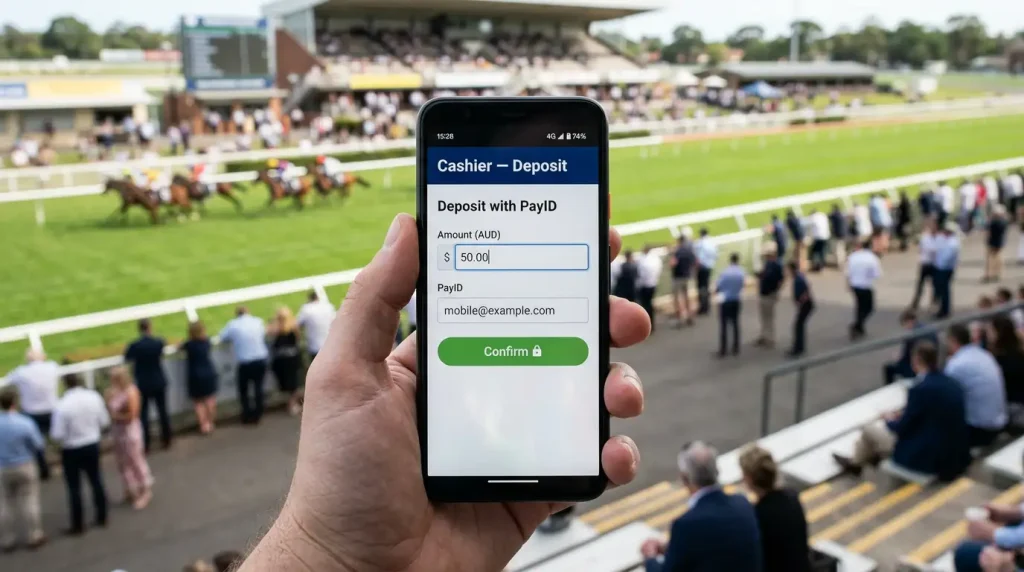
There is a specific twenty-minute window on a Saturday afternoon that tests every part of a betting cashier’s infrastructure. The metropolitan races and the big provincial meetings all converge in that window. Flemington, Rosehill, Doomben, Morphettville, Ascot – punters trying to back runners across multiple courses, jump by jump, within a compressed timeframe. If your PayID deposit is going to fail on any day of the racing year, it is going to fail on a Saturday afternoon.
That it almost never does is the quiet achievement of the NPP rail. I have watched racing Saturdays from the technical side of a bookmaker cashier and from the punter side, and in neither view have I seen PayID struggle with the load in any serious way. Understanding why, and what the practical timing implications are for racing bettors, is the point of this piece.
Why racing stresses the rail uniquely
Racing is different from other sports for deposit flow because the bet windows are short, repetitive, and overlap across courses. An AFL match runs for over two hours and accepts bets through most of that window. A cricket match lasts even longer. A horse race lasts maybe two minutes, with a final market-close moment roughly thirty seconds before the jump. If you missed a race because your deposit did not land in time, that specific market is gone.
Multiply that across a Saturday card with ten races at each of several courses and you have a day where punters are making dozens of deposit decisions against narrow time windows. Every one of those decisions translates into potential cashier traffic. A bookmaker running hundreds of thousands of racing punters generates millions of deposit events across a single major race day.
The NPP rail is engineered for exactly this kind of load. The rail processes more than 155 million real-time transactions per month across Australia, with peak capacity well above the observed average. Racing Saturdays represent a spike relative to the average but not a spike beyond what the infrastructure was designed to handle. Availability requirements for NPP operators are tight – downtime capped at around two minutes per month – which means the rail is effectively always on during racing windows.
The scale of wagering on Australian racing tells you why the racing-specific deposit pattern matters commercially. Australians wagered AU$244.3 billion in the 2022-23 financial year, with a substantial share of that flowing through racing markets. Online wagering specifically grew 165.7% in turnover during that period to AU$75.4 billion. Racing is a large share of both numbers, and the cashier infrastructure supporting it has had to scale to match.
The specific stress on racing days is not usually the rail itself but the bookmaker’s cashier reconciliation layer. When deposit volume peaks during the 1:30pm to 4:30pm window on a major Saturday, operator cashiers are matching thousands of incoming PayID payments against thousands of pre-issued references simultaneously. Well-engineered cashiers handle this cleanly. Poorly-engineered cashiers occasionally lag.
Typical deposit windows around a race
The practical timing pattern for a racing deposit runs like this, and understanding it prevents the specific flavour of problem I see most often.
A race jumps at, say, 3:00pm. Betting markets close roughly thirty seconds before the jump, so 2:59:30pm in this example. To place a bet on that race, the deposit has to be cleared and available in your cashier balance before market close. Working backwards from that moment, you need to factor in the time for your bank app handoff, the NPP settlement, the operator’s inbound reconciliation, and a safety buffer.
For an established PayID alias at a bookmaker you have used before, the total round-trip time from initiating the deposit to funds appearing in your cashier balance is typically thirty to sixty seconds on a weekday and can stretch to ninety seconds on a peak racing Saturday. For a first-time deposit at a new bookmaker, the time can be materially longer because of the 24-hour new-payee hold some banks apply, which I cover separately.
My practical rule for race-day deposits is a three-minute buffer from initiating the deposit to market close. This gives you time for the rail, the reconciliation, and a safety margin if anything unexpected happens. A deposit started at 2:56:30 for a race jumping at 3:00 will almost always land in time. A deposit started at 2:58:30 for the same race cuts the margin uncomfortably close.
If you are backing multiple runners across multiple races in a short window – which is the normal racing-day pattern rather than an edge case – the cumulative deposit load on your bank can be substantial. Banks apply daily PayID caps that limit how much you can send via the rail in a 24-hour window, and on a big racing day the cumulative total across multiple deposits can bump against the cap. Plan this in advance. I have covered the interaction between bank and bookmaker PayID caps in a dedicated piece for exactly this reason.
The single biggest race-day trap is sending funds into a cashier just before a jump without leaving time for reconciliation. The payment might be rail-settled inside thirty seconds but the operator’s cashier might not reflect it for another minute. Give it the full buffer. A bet placed a minute before jump is almost always better than a missed bet chasing zero buffer.
Bookmaker queue behaviour during peaks
Operators handle race-day peaks with a mixture of infrastructure scaling and queueing behaviour, and the queueing part is what punters sometimes notice.
During routine traffic – Tuesday afternoon, midweek meetings – PayID deposits reconcile as they arrive. The operator’s cashier backend sees the incoming payment, matches it to the issued reference, credits the account, and the balance updates. Total latency from bank-side send to cashier-visible credit is typically fifteen to thirty seconds.
During a racing Saturday peak, the operator’s reconciliation queue can back up. Not because the individual match takes longer – each reconciliation is still milliseconds of work – but because the incoming volume is higher than the queue can process instantaneously. The effect is a longer tail: 90% of deposits still reconcile inside thirty seconds, but the slowest 10% stretch to sixty or even ninety seconds.
For the punter this means the deposit you initiated might take marginally longer than usual to appear in your cashier during the 2:30pm to 3:30pm window on a major Saturday. This is not a failure. It is healthy queue behaviour under load. The deposit will land. The question is whether you left enough buffer for it to land before market close.
A well-engineered bookmaker cashier handles peak load without dropping payments or double-crediting them. The rail availability standard of two minutes of downtime per month means that even on the busiest racing day of the year, you are unlikely to encounter an outage. What you might encounter is temporary latency, and the practical response is simply to start your deposits earlier in the window.
Some operators actively communicate expected peak-window latency in advance of major racing days, particularly the Melbourne Cup and Spring Carnival events. A well-run cashier team posts a notice in the app recommending earlier deposits and larger buffers. Take those notices seriously. They reflect operator analytics on their own historical peak behaviour rather than generic marketing language.
A practical timing plan for a race day
Here is the playbook I recommend to any serious racing punter for a major Saturday.
Fund your main bookmaker account the day before. Not just to have funds available, but specifically to avoid any first-deposit holds or new-payee friction on the day itself. A AU$10 deposit on Friday evening establishes the PayID alias in your bank’s outbound history so that Saturday deposits run cleanly through the rail without any new-payee scoring layer applied.
Review your bank’s daily PayID cap the day before as well. If you plan to make cumulative deposits across the Saturday that would exceed your default cap, raise the limit through the bank app in advance rather than at the moment of deposit. Raising limits mid-afternoon during a peak window can take longer than usual because the bank’s verification flows are busier too.
On the day, plan deposits in clusters that align with race schedules rather than making many small deposits as you go. A cluster of AU$100 to cover three races at a given course is cleaner than five AU$20 deposits across the same three races. Fewer reconciliations means less exposure to queue latency, and the deposit cap on your bank covers larger single amounts more efficiently.
Keep the three-minute buffer rule in mind for every race. Deposit for a 3:00pm race by 2:57pm at the absolute latest. For a 3:30pm race, deposit by 3:27. If you miss a window, accept it and move on to the next race rather than chasing a late deposit that may not reconcile in time.
Have a backup payment option ready for the few cases where PayID does not work. Debit card as the secondary method is the standard choice at most licensed operators. Not every deposit will fail – in fact, the vast majority will not – but having a backup means a single rail issue does not derail an entire afternoon’s betting plan.
For broader race-day considerations beyond PayID – including how the rail behaves for in-play markets, short-window live bets, and quarter-time top-ups on codes like AFL and NRL – I cover the specifics of PayID deposits for live sports windows separately.
The final piece of practical advice: test your setup during a low-stakes week before a big race day. A Wednesday afternoon deposit at a new bookmaker tells you exactly how fast the cashier reconciles on your specific bank and alias combination. That test data is better than any general guidance I can give you, because every bank, every bookmaker, and every account has small quirks that only become visible under your own conditions.
The football codes behave differently: AFL and NRL live betting.
The wider context sits in our guide to PayID betting in Australia.
